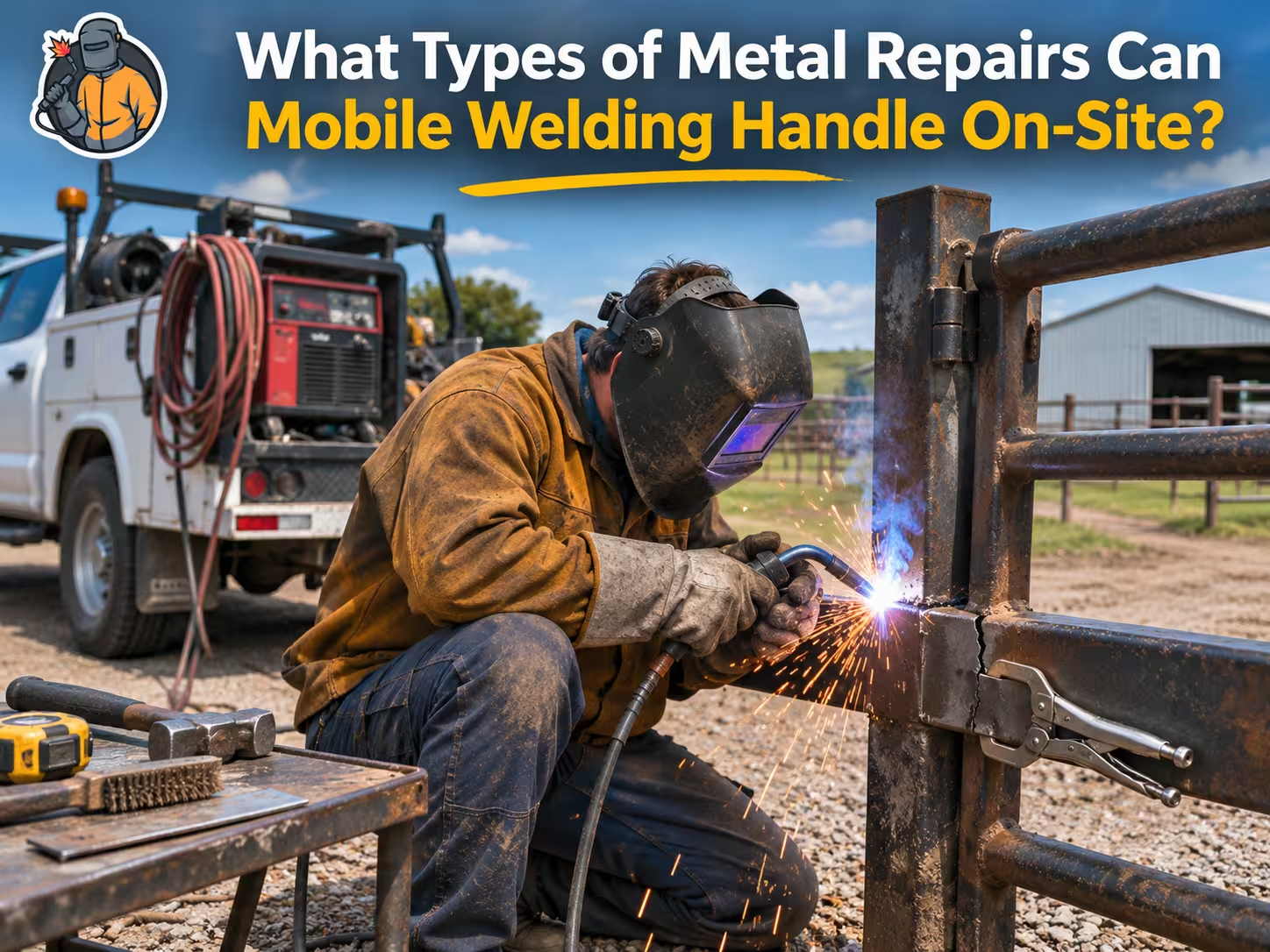
A warehouse gate develops a crack near its hinge, and the opening can no longer be secured properly. The gate is heavy, attached to steel posts, and difficult to remove without disrupting deliveries. Taking it to a workshop might involve more work than repairing the damaged connection.
Across town, a contractor needs twenty identical steel brackets fabricated for a renovation. Each bracket requires accurate measurements, repeatable cuts, and consistent welds. In this case, a fabrication shop may offer a more practical setting than bringing equipment to the construction site.
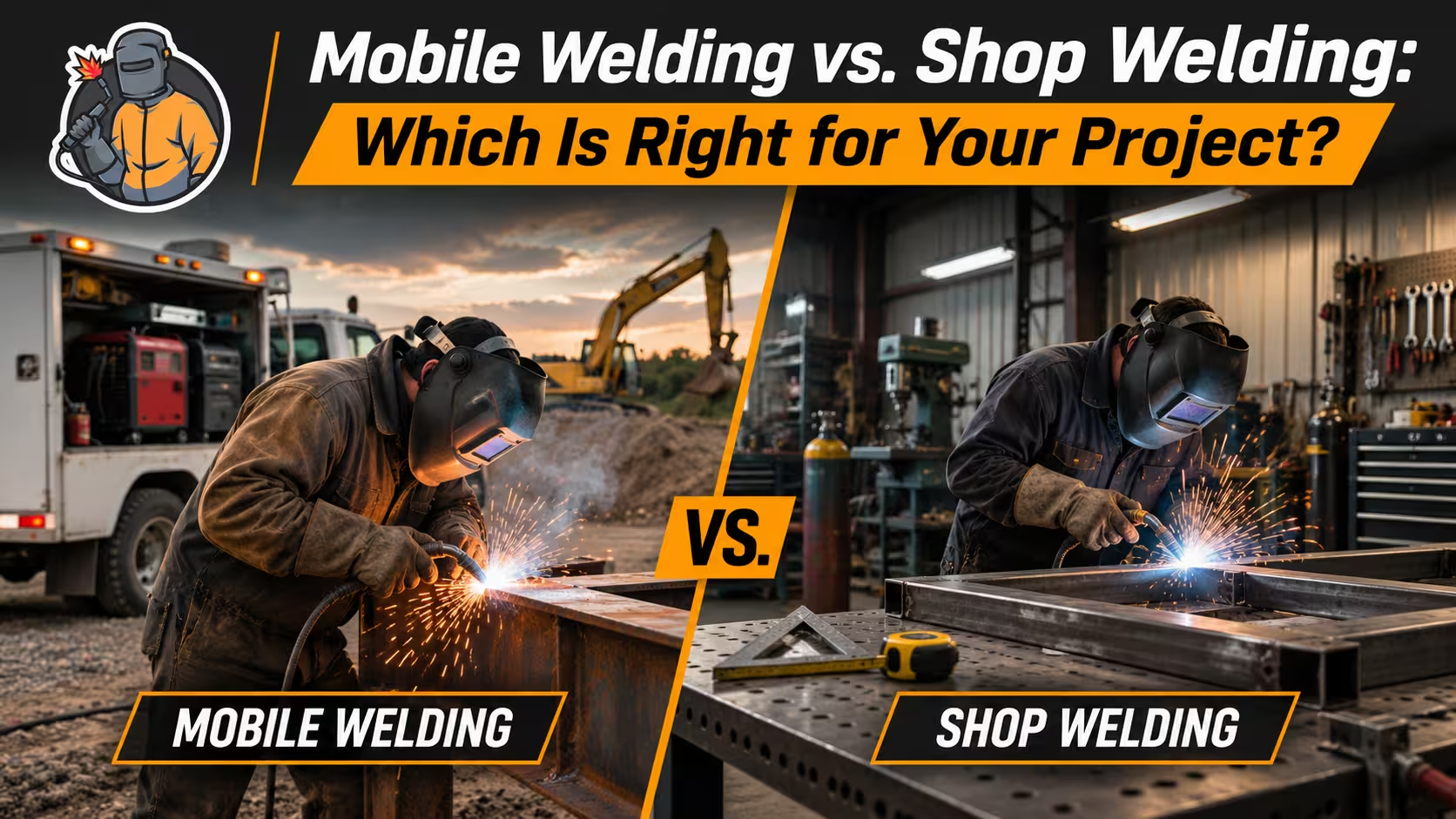
These situations illustrate the central question in mobile welding vs shop welding: where can the work be completed safely, accurately, and with the least unnecessary handling? The answer depends on the component, the welding procedure, and the conditions at each location.
What Is the Difference Between Mobile and Shop Welding?
Mobile welding brings suitable welding equipment and personnel to the project location. Shop welding takes place in a dedicated workshop, where materials and components are brought to stationary equipment and controlled work areas.
Neither approach automatically produces stronger welds. Weld quality depends on correct joint preparation, materials, qualified personnel where required, an appropriate welding procedure, and inspection. The location matters because it affects how consistently those requirements can be met.
| Decision Factor | Mobile Welding | Shop Welding |
| Component location | Work occurs where the metal is installed | Component travels to the workshop |
| Access | Depends on room around the installed joint | Easier to reposition many loose parts |
| Environment | Weather and nearby operations may interfere | More control over wind, lighting, and cleanliness |
| Equipment | Portable tools selected for the job | Stationary fixtures and fabrication machines may be available |
| Transportation | Can avoid moving large assemblies | May require lifting, hauling, or disassembly |
| Best fit | Installed repairs and final-site connections | Repetitive fabrication and complex bench work |
When Does Mobile Welding Make More Sense?
The strongest case for on-site welding is a component that is difficult to move but can be reached and repaired safely where it stands.
Installed Gates, Railings, and Steel Connections
Consider a commercial gate with a cracked hinge attachment. A welder can inspect the gate’s alignment, hinge condition, and surrounding steel while everything remains installed. If the connection is repairable, fieldwork may avoid removing and transporting the gate.
Equipment That Cannot Easily Leave the Site
Some industrial equipment contains large frames, guards, and mounting brackets. Moving an entire machine for a small localized repair could require extensive disassembly.
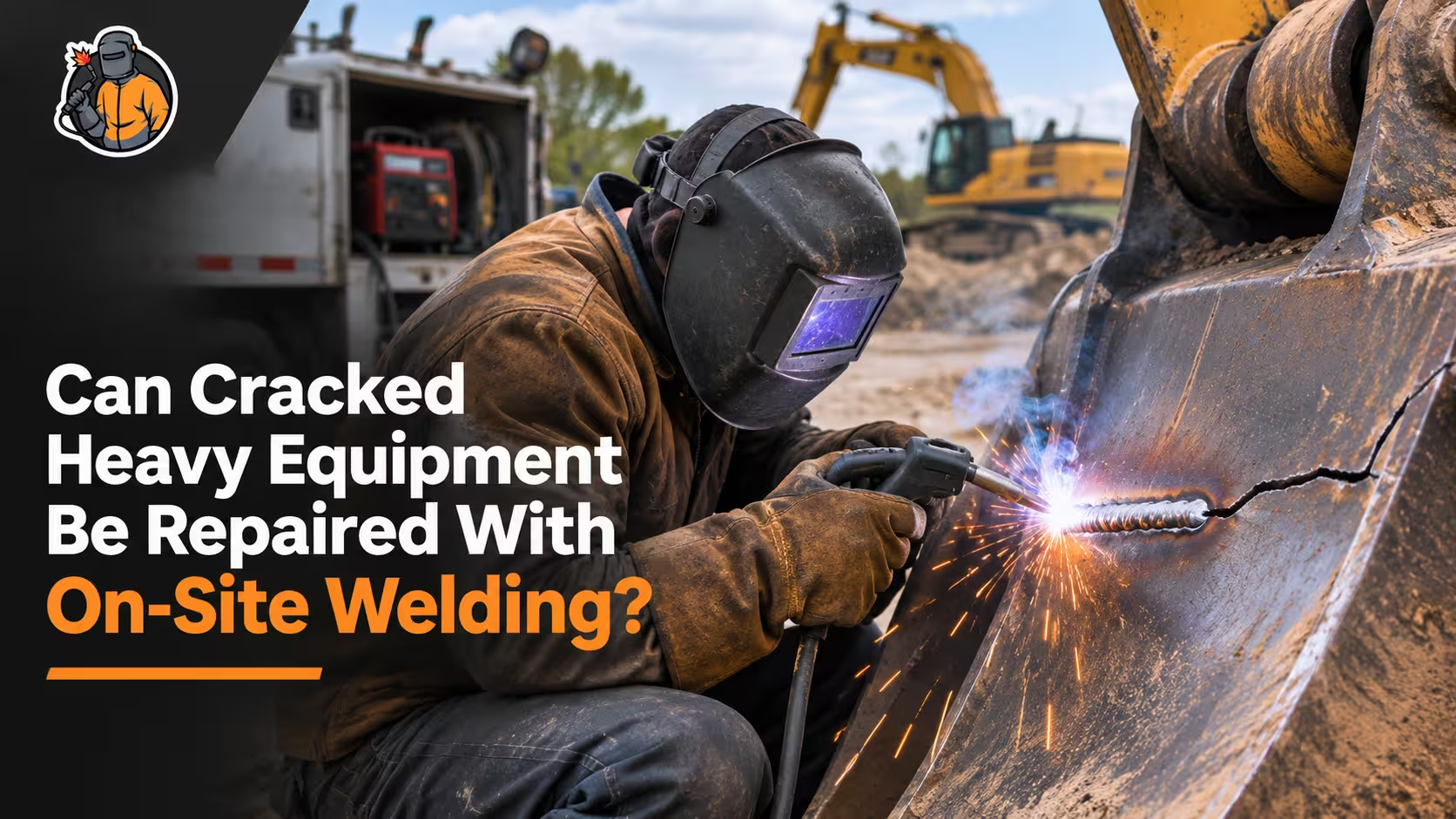
Mobile welding services may reduce handling and downtime when the damaged area is accessible and the component is approved for field repair. A machine should still be properly isolated before work begins. Cracks in load-bearing frames or critical connections may require manufacturer guidance or engineering review.
Final Connections During Construction
A metal assembly may be fabricated in a shop but require final fitting at a construction site. Field welding can accommodate approved connections after components are positioned.
When Is a Welding Shop the Better Choice?
A controlled welding environment is especially valuable when the work requires repeatable positioning, specialized machinery, or extensive fabrication.
Repetitive or Precision Fabrication
Suppose a contractor needs multiple matching steel brackets. A metal fabrication workshop can provide dedicated cutting equipment, assembly tables, clamps, and fixtures to maintain consistent dimensions.
Components That Need Repositioning
Some welds are difficult to reach when a component remains installed. In a shop, technicians may be able to rotate the part, secure it in a fixture, and access the joint from a better welding position.
Work Requiring Tight Environmental Control
Wind can disrupt shielding gas during certain MIG or TIG welding applications. Moisture, contamination, and poor lighting can also complicate fieldwork.
A workshop can offer more predictable conditions for these processes.
Does Welding Location Affect Weld Quality?
Yes, but indirectly. A correctly executed field weld can satisfy applicable requirements, while a poorly prepared shop weld can fail inspection. The key is whether the selected location allows the welding procedure to be followed reliably.
For some jobs, a Welding Procedure Specification (WPS) establishes variables such as the process, materials, joint preparation, and welding parameters. A qualified contractor must follow applicable project requirements rather than substitute a convenient technique.
Helpful note: If the installed joint cannot be cleaned, accessed, welded, and inspected properly, transporting the component to a shop may be the better decision even when field equipment is available.
How Do Transportation, Downtime, and Cost Compare?
Comparing only the welder’s hourly rate can be misleading. The full project may involve disassembly, lifting equipment, transportation, site preparation, fabrication, reinstallation, and inspection.
For a large installed gate, field welding vs shop welding often comes down to how much handling can be avoided. A field repair might eliminate hauling, but it could require additional protection of nearby property and coordination around business hours.
For a batch of small parts, workshop production may save time through repeatable setups. Transporting those parts may be simple compared with setting up fabrication equipment at the site.
Before deciding, compare these practical questions:
- Can the component be moved safely? Consider weight, dimensions, attachment points, and lifting needs.
- How much disassembly is involved? Removing adjacent equipment can add substantial work.
- Can the joint be accessed properly? Preparation and inspection space matter.
- Will operations need to stop? Both site welding and removal may disrupt normal activity.
- Does the job need specialized equipment? Some fabrication tasks are better suited to workshop machinery.
What Safety Issues Influence the Decision?
Outdoor welding conditions can change quickly, especially during Portland’s wet months. Rain creates electrical safety concerns, while wind can affect gas-shielded processes. Work may need weather protection or rescheduling.
At occupied properties, welding sparks and heat also create fire risks around packaging, landscaping, coatings, and other combustible materials. Industrial sites may require hot-work authorization, hazardous-energy isolation, and coordination with other trades.
How Should You Choose for Your Project?
Start with the work itself, not the availability of a welding truck or workshop. A useful welding project preparation process includes photographing the component, identifying its material if known, and explaining how it is used.
Then ask a contractor to assess the following:
- Repair feasibility: Is the existing metal sound enough to repair, or is replacement needed?
- Joint accessibility: Can the area be prepared and inspected in its current position?
- Project complexity: Does the work require extensive cutting, fitting, or precision fabrication?
- Safety requirements: Are there load-bearing functions, fire hazards, or operational restrictions?
- Total handling: What must be removed, transported, or reinstalled under each option?
For example, a cracked mounting bracket on stationary equipment might be repaired on-site if the surrounding material is sound and the procedure is suitable. A severely distorted bracket may be better fabricated in a shop and installed afterward.
Complete Fusion Welding LLC serves projects in Portland, Oregon, with welding and metal fabrication capabilities. Its mobile welding services provide an option for work that can appropriately be completed at the project location. Discussing the component and site conditions first helps determine the right approach.
Frequently Asked Questions
Is Mobile Welding Lower Quality Than Shop Welding?
Not inherently. Weld quality depends on material preparation, procedure selection, execution, and inspection. A field location must allow those requirements to be met.
Is Mobile Welding Always Faster?
No. It may avoid transportation and disassembly, but travel, site access, weather, and safety preparation can affect timing. Shop fabrication may be faster for repeated parts.
Can Stainless Steel Be Welded On-Site?
Some stainless steel projects are suitable for field welding. Material grade, cleanliness, shielding requirements, and working conditions determine whether the process is practical.
Should Damaged Equipment Be Repaired or Replaced?
That depends on the damage, material condition, operating loads, and applicable requirements. Critical equipment may need manufacturer guidance or engineering assessment before either option is selected.
Choose the Welding Location That Fits the Work
The right choice in on-site welding vs shop welding depends on more than convenience. Installed components and difficult-to-move assemblies often favor fieldwork, while repeatable fabrication, complex positioning, and tightly controlled processes may favor a workshop.
Some projects need both: shop-built replacement parts followed by installation at the property. For welding work in Portland, OR, Complete Fusion Welding LLC can discuss your project requirements and help determine whether mobile welding is an appropriate starting point.