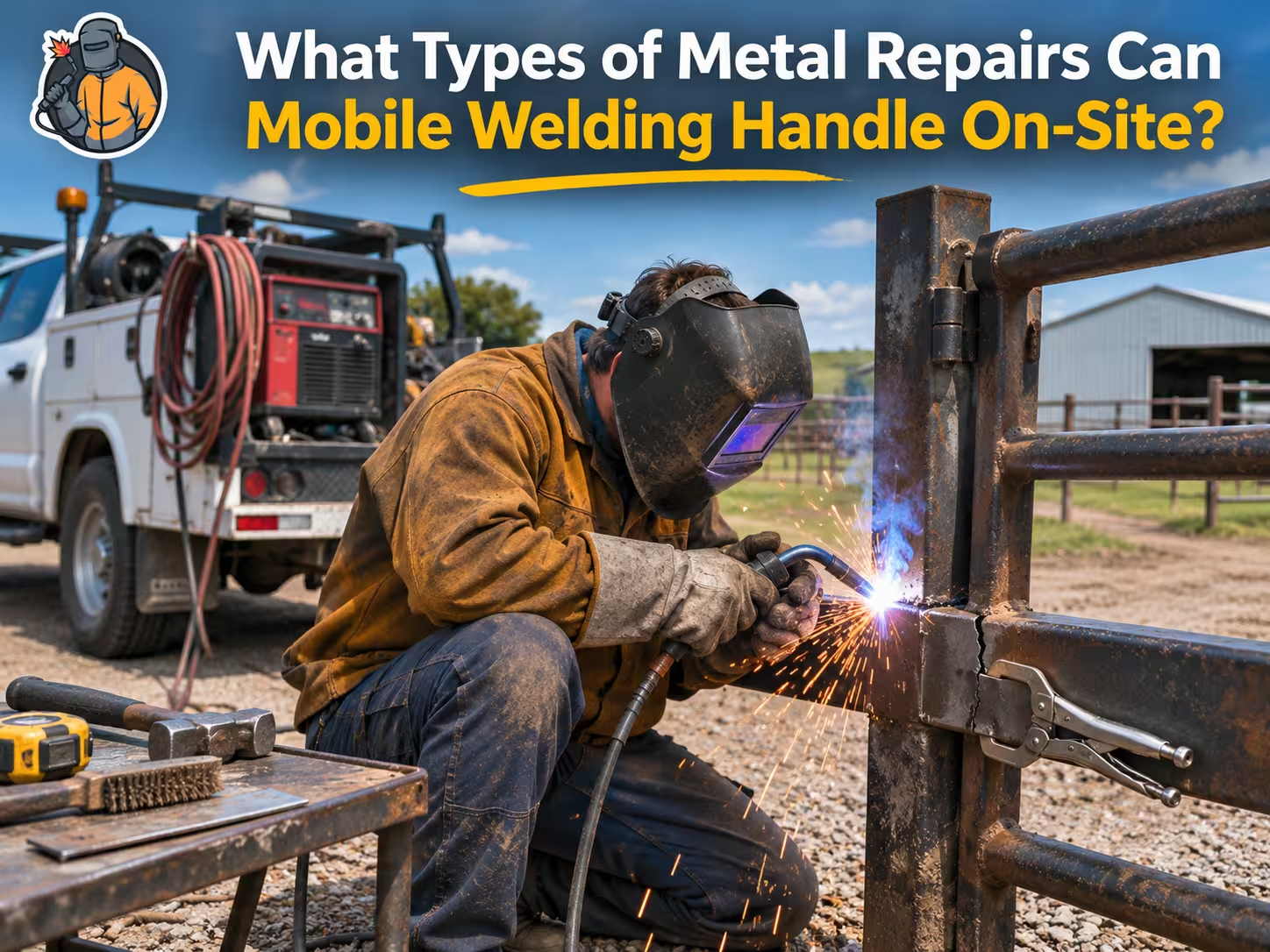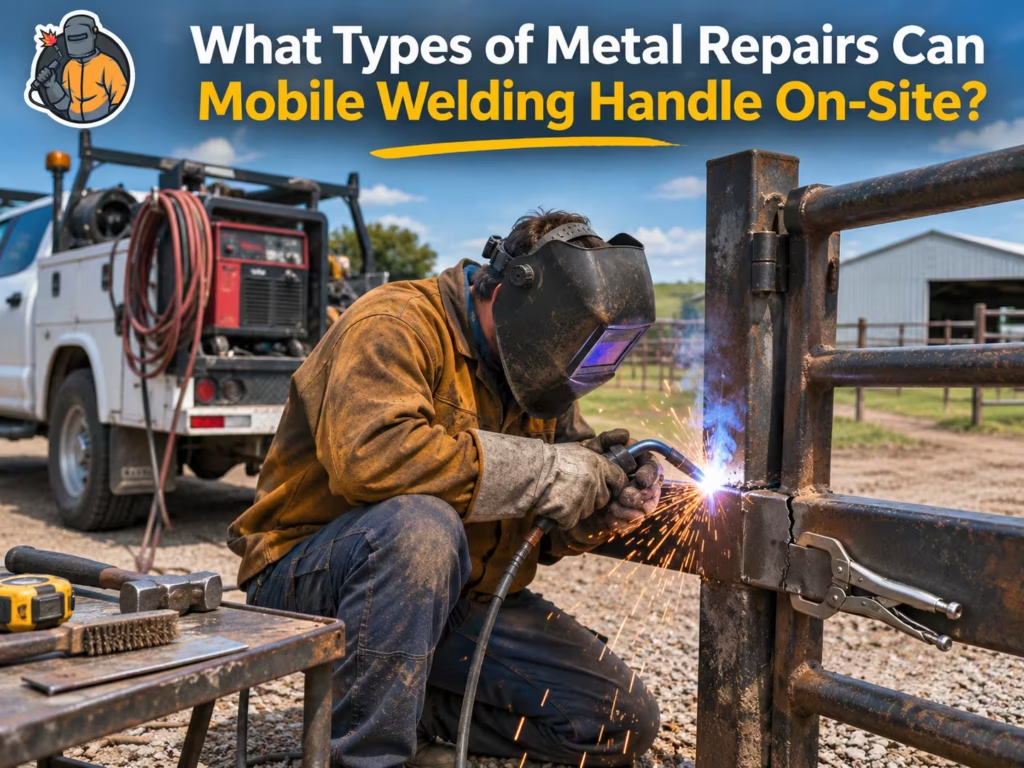
A steel gate stops closing properly because its hinge connection has cracked. A construction machine develops a damaged mounting bracket, or a warehouse railing becomes loose after repeated impacts. These problems can interrupt operations, create safety concerns, and leave property owners wondering whether the entire component needs replacement.
Fortunately, mobile welding repairs can address many types of metal damage without transporting large equipment or permanently installed structures to a workshop. Common applications include cracked steel joints, damaged gates, broken railings, equipment brackets, and certain industrial metal components.
However, not every damaged part is suitable for field welding. The material, crack location, structural condition, and accessibility determine whether an on-site repair is practical. Understanding these differences helps you decide when welding makes sense and when replacement is the safer option.
Which Metal Components Can Be Repaired With Mobile Welding?
Mobile welding is particularly useful when damaged components are difficult to remove, transport, or replace. Instead of dismantling an entire assembly, a welder can inspect the affected area and determine whether the existing metal can support a suitable repair.
Several common situations demonstrate where on-site metal repair may be appropriate.
Cracked Metal Gates and Damaged Hinges
A commercial entrance gate may begin sagging because its welded hinge bracket has cracked. Continued operation places additional stress on the connection, potentially causing further damage.
In this situation, metal gate welding repair may involve removing the damaged weld, preparing the metal surfaces, correcting alignment, and creating a suitable replacement joint.
However, the hinge itself might be worn, or the gate may be placing excessive weight on its mounting points. Repairing the crack without addressing these conditions could lead to another failure.
A professional assessment should identify both the visible damage and its underlying cause.
Broken Steel Railings and Safety Barriers
Steel railings, stairway handrails, and protective barriers can develop loose connections, cracked joints, or damaged mounting plates.
Imagine a warehouse railing that moves when someone leans against it. The problem could involve a failed weld, a weakened support, or corrosion around the base.
Steel railing repair may restore the connection when the surrounding metal remains structurally sound.
However, safety barriers must withstand their required loads. A repair that looks secure isn’t necessarily sufficient. Applicable building requirements and the railing’s intended function must be considered before returning it to service.
Damaged Brackets and Metal Supports
Metal brackets support equipment, machinery guards, platforms, and other assemblies. Repeated vibration or accidental impacts can cause cracks near their welded connections.
For noncritical components, field welding may offer a practical repair option. More heavily loaded supports may require additional evaluation.
The key question isn’t simply whether the bracket can be welded. It’s whether the repaired connection can safely perform its original function.
Can Cracked Heavy Equipment Be Repaired On-Site?
Construction equipment and industrial machinery often contain large welded steel assemblies. Removing damaged components can require substantial disassembly or specialized transportation.
Consider an excavator that develops a crack near a mounting connection. An on-site assessment may help determine whether the affected component can be repaired without moving the entire machine.
However, equipment frame welding requires careful consideration because many machinery components experience repeated loading, vibration, and significant mechanical stress.
What Causes Equipment Frames to Crack?
Several conditions contribute to equipment damage:
- Metal fatigue from repeated loading
- Excessive vibration during operation
- Impact damage from heavy materials
- Corrosion that weakens existing connections
- Poor alignment or concentrated stress
- Previous weld defects or unsuitable repairs
A crack that repeatedly develops in the same location may indicate an unresolved mechanical problem.
Simply welding over the visible damage doesn’t necessarily eliminate that problem.
When Is Equipment Welding Unsafe?
Cracks affecting load-bearing frames, lifting components, or critical machinery connections may require manufacturer-approved procedures or engineering evaluation.
Welding also creates a heat-affected zone (HAZ), where heat can alter the properties of the surrounding metal.
An unsuitable welding procedure may weaken certain materials or introduce additional stresses.
Before attempting heavy equipment repairs, the material, operating loads, and consequences of failure must be evaluated. Some components are better replaced than repaired.
How Can Mobile Welding Address Industrial Metal Damage?
Industrial facilities contain numerous welded components that support production equipment, material handling, and daily operations. A cracked machine bracket, damaged equipment support, or broken protective barrier may interrupt work until the affected component is repaired.
Field welding repairs can sometimes address these problems without removing large assemblies.
For example, a manufacturing facility discovers that a steel mounting bracket has separated from a stationary equipment frame. If the machine can be safely isolated and the surrounding material remains suitable, welding at the facility may reduce the need for disassembly and transportation.
However, industrial repairs require coordination with maintenance personnel. Machinery must be properly shut down, hazardous energy controlled, and nearby operations protected.
For businesses in Portland, OR, Complete Fusion Welding LLC provides welding and metal fabrication services for commercial and industrial applications.
The company’s mobile welding service offers a way to discuss suitable repairs at the equipment’s location rather than automatically transporting damaged components to a fabrication shop.
What Determines Whether Damaged Metal Can Be Welded?
Two components with similar-looking cracks may require completely different repair approaches.
Before selecting a welding procedure, several factors must be considered.
Metal Type and Condition
Carbon steel and stainless steel are commonly weldable materials, but their welding requirements differ.
Some cast metals, heat-treated alloys, and unidentified materials present additional challenges.
The condition of the existing metal is equally important. A localized crack in otherwise sound steel may be repairable, while extensive corrosion can leave insufficient material to support a reliable weld.
Paint, coatings, oil, and contamination may also require special preparation or safety controls.
Crack Location and Structural Importance
A crack in a decorative metal attachment is different from one affecting a load-bearing support.
The assessment should establish how far the crack extends, whether additional damage exists, and what forces the component experiences during operation.
A welding inspection may involve visual examination and, where necessary, non-destructive testing to identify defects that aren’t immediately visible.
Worksite Accessibility
Even when a component is technically repairable, restricted access may prevent proper welding.
The welder needs sufficient space for joint preparation, equipment positioning, and inspection.
If the damaged area cannot be reached safely, removing the component for workshop repair may be more appropriate.
Which Welding Processes Are Suitable for On-Site Repairs?
Different materials and working conditions require different welding processes.
Shielded Metal Arc Welding (SMAW), commonly called stick welding, is frequently suitable for outdoor steel applications because it doesn’t require an external shielding-gas supply.
Gas Metal Arc Welding (GMAW), commonly called MIG welding, can provide efficient welding for suitable components. However, wind can interfere with shielding gas and affect weld quality.
Gas Tungsten Arc Welding (GTAW), commonly called TIG welding, provides precise control for certain applications, including stainless steel fabrication and repairs.
The appropriate method depends on the metal, joint configuration, working conditions, and repair requirements.
A damaged outdoor steel bracket may need a different procedure from a thin stainless steel component, even when both are repaired at the same property.
Complete Fusion Welding LLC offers mobile welding services for suitable on-site repair and fabrication needs. Sharing photographs, material details, and information about the damaged component can help establish whether a field assessment is appropriate.
When Is Metal Replacement Better Than Welding Repair?
Not every cracked or broken component should be welded.
Consider an outdoor steel railing with several cracked connections and extensive corrosion around its base. Welding the visible cracks may not restore the strength of the surrounding material.
Replacing the affected section could provide a more dependable solution.
Replacement or shop-based fabrication deserves consideration when:
- Corrosion has significantly reduced metal thickness.
- Multiple cracks indicate widespread fatigue.
- The component has substantial deformation.
- The original material cannot be reliably identified.
- An appropriate repair procedure cannot be established.
- The worksite cannot be made safe for welding.
Another important consideration is the cause of the original failure.
If poor alignment, excessive loading, or repeated movement caused the damage, these conditions must be corrected to reduce the likelihood of another failure.
In some cases, metal fabrication repair involves manufacturing a replacement bracket or metal section rather than rebuilding the original component.
A dependable repair should address the component’s function, not merely improve its appearance.
What Safety Precautions Are Necessary During Field Welding?
On-site welding introduces risks that must be controlled before work begins.
Sparks, molten metal, welding fumes, electrical equipment, and nearby combustible materials can create hazardous conditions.
For example, welding a damaged steel gate beside stored cardboard or flammable products requires careful worksite preparation.
The Occupational Safety and Health Administration (OSHA) addresses welding safety under 29 CFR 1910.252, including fire prevention, ventilation, and personal protection.
Depending on the site, precautions may involve removing combustible materials, protecting nearby workers, controlling hazardous energy, and establishing appropriate fire-watch arrangements.
Portland’s wet weather can also affect outdoor welding conditions. Moisture introduces electrical safety concerns, while wind can interfere with gas-shielded welding.
Welding should not proceed when environmental conditions prevent safe operation or acceptable weld quality.
How Should You Prepare for an On-Site Welding Repair?
Before contacting a welding contractor, gather enough information to describe the problem accurately.
Start by photographing the damaged area and the surrounding assembly. Close-up images show cracks, while wider photographs help explain the component’s location and accessibility.
Then prepare the following information:
- Component details: Identify whether the damage affects a gate, railing, equipment frame, bracket, or another metal assembly.
- Damage description: Explain any cracks, corrosion, broken connections, deformation, or unusual movement.
- Material information: Provide the metal type if known, along with available manufacturer specifications.
- Site conditions: Describe access restrictions, nearby machinery, working height, and available space.
- Safety concerns: Mention load-bearing components, active equipment, combustible materials, or other hazards.
Avoid operating damaged machinery or attempting temporary welding on safety-critical components without proper evaluation.
Accurate information helps the welding contractor determine whether an inspection, repair procedure, or replacement assessment is needed.
Frequently Asked Questions
Can a Mobile Welder Repair a Cracked Steel Gate?
Yes, many cracked steel gate connections can be repaired on-site when the surrounding metal remains sound. The welder should also examine hinge condition, alignment, and mounting points to identify the cause of the damage.
Can Rusted Metal Be Repaired With Welding?
Sometimes. Surface rust can often be removed during preparation, but severe corrosion may leave insufficient metal for a reliable repair. The remaining material thickness and structural condition determine whether welding is appropriate.
Can Heavy Machinery Be Welded Without Moving It?
Certain machinery components can be repaired at their installed location. However, critical frames and load-bearing connections may require manufacturer guidance, specialized inspection, or engineering approval before repair.
Does Welding Restore the Original Strength of Damaged Metal?
Not automatically. Repair performance depends on the material, welding procedure, joint design, and cause of failure. Some components require testing or engineering evaluation before returning to service.
How Do You Know When Metal Should Be Replaced?
Replacement may be preferable when corrosion, deformation, extensive cracking, or material deterioration makes a reliable repair impractical. A professional assessment can help compare the available options.
Choosing the Right Solution for Damaged Metal Components
Cracked gates, broken railings, damaged brackets, and certain machinery components can often be evaluated for on-site welding. However, repair feasibility depends on material condition, structural requirements, accessibility, and safety.
The most useful approach is identifying the cause of the damage before deciding how to repair it.
Complete Fusion Welding LLC provides mobile welding and metal fabrication services in Portland, OR, helping residential, commercial, and industrial customers explore suitable repair options.
For damaged metal components that may require professional welding, contact Complete Fusion Welding LLC at 360-232-2051 to discuss the problem, location, and appropriate next steps.