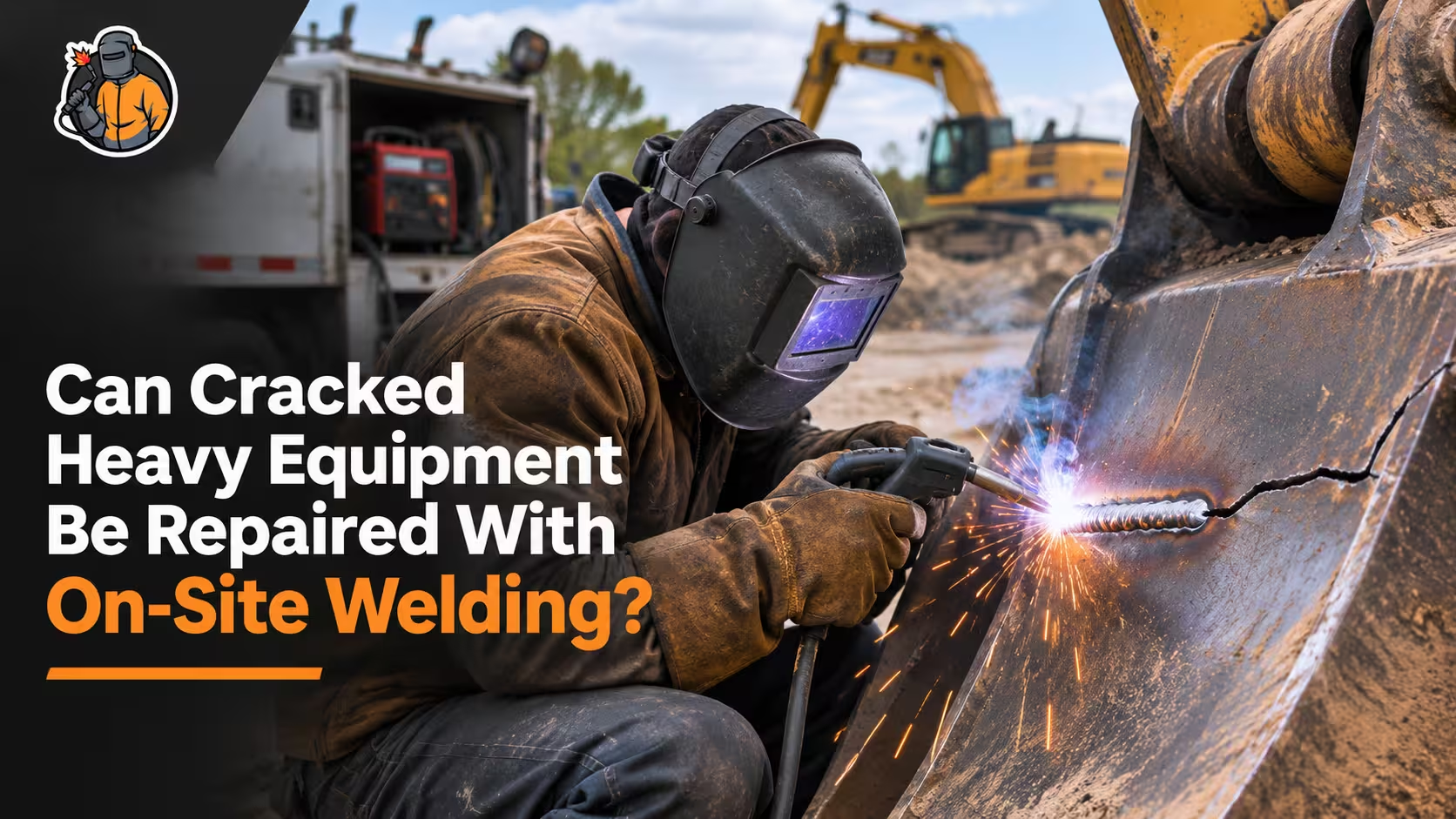
An excavator operator notices a thin crack beside a boom mounting bracket during a routine walkaround. The machine still moves, but continuing to work could make the damage worse. Moving it to a repair facility would also interrupt the job and require transport arrangements.
At another site, a wheel loader has a cracked bucket wear plate. A similar-looking crack elsewhere could extend into a highly stressed structural connection.
Heavy equipment welding repair can sometimes restore damaged steel components without transporting the entire machine. The question is whether an approved repair can return the component safely to service.
Why Do Heavy Equipment Components Crack?
Excavators, loaders, backhoes, and other construction machines experience repeated forces during digging, lifting, pushing, and travel. Over time, those forces can contribute to fatigue cracking, particularly around welded joints and abrupt changes in component shape.
Common contributors include:
- Repeated loading: Cycles of stress can initiate and extend fatigue cracks.
- Impact: Contact with rocks, debris, or other equipment may deform or fracture steel.
- Misalignment: Worn pins, bushings, or attachments can change how loads pass through a structure.
- Corrosion: Material loss can reduce the section available to carry loads.
- Previous repairs: Poor joint preparation or an unsuitable procedure may leave defects or introduce additional stress concentrations.
Which Equipment Cracks Might Be Repairable On-Site?
On-site equipment welding may be practical when the damaged area is accessible, the material is identified, and an approved repair approach is available. The component’s function matters more than the crack’s apparent size.
| Component or Damage | Initial Repair Consideration |
| Replaceable bucket wear plate | May be suitable for field repair or replacement under the applicable procedure |
| Noncritical steel guard or bracket | Often worth assessing for a localized repair |
| Cracked loader bucket shell | Requires examination of crack extent, loading, and material |
| Excavator boom or stick | High-consequence structure; seek OEM guidance and qualified engineering assessment |
| Lifting point or load-bearing attachment | Do not assume field welding is permitted; applicable design and inspection requirements govern |
| Hydraulic cylinder rod or pressure-containing part | Specialized component; ordinary structural welding is not an appropriate default |
How Should Cracked Machinery Be Inspected?
An effective equipment crack inspection looks beyond the visible line. It identifies the material, the full extent of damage, and the consequences if the component fails.
Step 1: Stop and Secure the Equipment
If a crack may affect structural integrity, stop using the affected function and follow site safety procedures. Park and stabilize the machine as directed by the manufacturer, relieve stored energy where applicable, and prevent unintended movement. Do not place anyone beneath unsupported attachments.
Step 2: Identify the Component and Its Loads
Record the machine model, component location, material information, and operating history. Determine whether the part carries digging, lifting, steering, braking, or other critical loads. Manufacturer documentation may identify repair restrictions or required replacement.
Step 3: Examine the Crack and Surrounding Metal
Inspect for distortion, corrosion, earlier weld repairs, and cracks branching away from the obvious damage. Cleaning may reveal details hidden by paint or grease, but preparation must not erase evidence needed for assessment.
For steel, qualified inspectors may use magnetic particle testing (MT) or other non-destructive testing (NDT) to assess cracks beyond what is visible.
Step 4: Decide Whether Repair Is Authorized
A repair decision may require the original equipment manufacturer (OEM), a qualified engineer, or both. If the required material data, repair procedure, or acceptance criteria are unavailable, replacement or specialist evaluation may be the responsible choice.
What Does a Proper Welding Repair Involve?
Once repair feasibility is established, the work should follow a documented approach appropriate to the component. Field welding repairs are not simply a matter of running a bead across the crack.
A typical sequence may include:
- Plan the repair. Confirm approved joint details, material requirements, inspection criteria, and whether disassembly is necessary.
- Prepare the area. Remove contamination and damaged material as specified, and establish safe access and fire controls.
- Control welding variables. Follow the applicable Welding Procedure Specification (WPS), including filler metal, preheat, interpass temperature, and other essential variables where required.
- Manage distortion. Use suitable positioning and sequencing to avoid introducing harmful misalignment or residual stress.
- Inspect the finished work. Complete the required visual examination and any specified NDT before authorizing return to service.
Welding changes the surrounding material in the heat-affected zone (HAZ). Depending on the steel grade and heat input, that change can influence hardness, toughness, and cracking susceptibility. This is one reason manufacturer-approved procedures matter for machinery structures.
Helpful note: A smooth-looking weld does not prove that a repaired boom, frame, or lifting attachment is safe. Acceptance depends on the applicable design, procedure, and inspection requirements.
When Is Replacement Safer Than Welding?
Replacement deserves serious consideration when damage extends beyond a localized, repairable area or the component cannot be restored to its required performance.
Warning signs include multiple fatigue cracks, severe deformation, substantial corrosion, uncertain material composition, or repeat cracking after earlier repairs. Replacement may also be required when the OEM prohibits welding on a particular component.
Consider an excavator boom with cracking near a highly loaded pin connection. A quick surface weld could conceal the visible defect without resolving fatigue damage or stress concentration. The correct next step is an engineering and manufacturer-guided assessment, not an improvised job-site patch.
What Makes Heavy Machinery Welding Difficult at a Job Site?
Mobile equipment welding avoids some transportation challenges, but the site must support safe work and adequate quality control.
Access: Cracks may be hidden behind hydraulic lines, guards, or tightly fitted assemblies. Proper preparation and inspection may require removing adjacent parts.
Environment: Rain, moisture, and wind can affect electrical safety and shielding gas performance. Portland, Oregon, job sites may need weather protection or a different repair schedule.
Fire and fluid hazards: Grease, fuel, hydraulic oil, hoses, and nearby combustible materials create risks. Equipment must be isolated and prepared according to applicable hot-work and maintenance procedures.
Welding position: Restricted joint access can make consistent welding difficult. A shop may allow the component to be rotated or supported more effectively.
How Can Owners Prepare for a Repair Assessment?
Before requesting heavy machinery welding repair, collect information that helps the contractor assess the problem without making assumptions.
- Photograph the crack close up and from farther away to show its location.
- Record the machine make, model, and affected component.
- Note when the damage was discovered and whether it has grown.
- Describe any impact, unusual noise, deformation, or earlier repair.
- Identify access restrictions and whether the machine can be safely isolated.
- Share relevant OEM service instructions or inspection findings, if available.
Avoid grinding out the crack, welding over it, or continuing to operate a potentially unsafe component before a qualified assessment. Early documentation can also help distinguish the original damage from changes caused by later operation.
For businesses around Portland, Complete Fusion Welding LLC provides mobile welding services and metal fabrication capabilities. A discussion of the component, site conditions, and available documentation can help establish whether an on-site assessment is appropriate. Specific critical-equipment repairs should only proceed when the required expertise, approvals, and procedures are in place.
Frequently Asked Questions
Can an Excavator Boom Crack Be Welded?
Sometimes, but boom cracks can affect critical load-bearing structures. Follow OEM instructions and obtain qualified engineering assessment where required. Do not assume a field weld is an acceptable repair.
Can a Cracked Loader Bucket Be Repaired at the Job Site?
Certain bucket wear components and localized steel damage may be suitable for field repair. Cracks in primary structural areas need a closer assessment of material, loads, and approved procedures.
Is Non-Destructive Testing Always Necessary?
Not for every minor component, but critical repairs may require NDT before and after welding. The method and acceptance criteria depend on the component and governing requirements.
Does Welding Make a Cracked Frame Strong Again?
Not automatically. Repair performance depends on the original material, cause of cracking, joint design, procedure, and inspection. Some damaged frames should be replaced rather than welded.
Make Repairability the First Decision
Cracked construction machinery does not always require transporting an entire machine to a workshop. Industrial equipment welding may be a practical option for suitable steel components when access, materials, and approved procedures allow safe fieldwork.
But heavy equipment carries substantial loads, and an incorrect repair can create serious consequences. Identify why the crack formed, establish whether welding is permitted, and confirm inspection requirements before returning the machine to operation.
Complete Fusion Welding LLC serves the Portland area with welding and fabrication services. If equipment has a damaged metal component, contact the team to discuss the problem and determine whether mobile welding is an appropriate next step, subject to the necessary technical evaluation.